Article
Tap and Die Basics
When you have a worn out screw or bolt, a tap and die set will come in handy. Learn the basics of how to use one with Blain's Farm & Fleet.
Read More September 9, 2015 | Blain's Farm & FleetTool Box: If you’re building up your collection of hand tools for your home, be sure to protect them by storing them in something sturdy and protective. Rugged doesn’t have to mean enormous or costly when it comes to toolboxes. There are many options available at all price points – even for cozy homes or apartments where storage space is minimal.
Hammer: The most critical hand tool of them all, an absolute must to have in your toolbox as you’ll use a hammer for everything from hanging pictures to installing decorative molding. A great option is the claw hammer with a steel head on one side and a claw – the crowbar-like nail-pulling lever – on the other.
Tape Measure: You can’t put a price on accuracy, especially when it comes to home improvement. Incorrect estimates can end up costing you both time and money, so save yourself the trouble by simply keeping a tape measure in your toolbox.
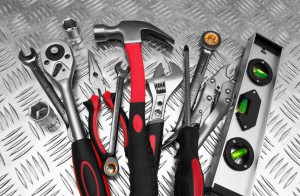
Level: Wondering if that picture you’re hanging or chair rail you’re affixing is straight? It sounds like you could use a level. While there are many high-tech laser levels available today, standard torpedo levels, which use air bubbles in three clear liquid-filled vials to give you visible proof of a surface’s level, are still a great and low-cost choice. Regardless of the type you pick, you’ll be happy to have a level in your toolbox.
Screwdrivers: Because there are so many different screw designs, it’s a good idea to stock your tool kit with different types of screwdrivers. A screw’s “drive type” is defined by the shape or design stamped into its head, which a screwdriver blade fits into to drive or extract it. You can always opt for a multi-bit screwdriver to save money and toolbox space.
Pliers and Wrench: Both pliers and wrenches provide extra grip and leverage for projects around the house, but owning one of each is best since they’re cut out for slightly different jobs. Pliers are great for pulling out nails, bending, and even cutting wire. A wrench is the tool to grab when you need grip combined with extra torque for tightening and loosening pipes or turning nuts and bolts.
Utility Knife: A utility knife – also called a box cutter, razor knife, or carpet knife – comprises a hollow plastic or metal handle that houses a retractable razor blade. Utility knives are handy tools for any do-it-yourself-er, regardless of their skill level. They make quick work of slicing through cardboard, drywall, carpet, thin plastics, and even linoleum.
With these toolbox basics, you’ll be prepared to tackle any job needed to be done around the house. For more tips and tool how-to’s, check out Blain’s Farm & Fleet’s Tools blog.