How ToArticle
How To Install A Car Battery
Do you know how to replace the battery in your car or truck? You're in the right place to learn how to install a car battery.
Read More March 30, 2023 | Blain's Farm & FleetMaintaining proper tire pressure is crucial for your safety, fuel efficiency, and overall performance of your vehicle. And finding the perfect tire pressure gauge will ensure that your tires are always properly inflated and ready to hit the road.
Fortunately, you have plenty of options to choose from based on your specific needs. Are you looking for the most accurate tire gauge? The least expensive? The one that’s easiest to store?
At Blain’s Farm & Fleet, we understand that choosing the right tire pressure gauge can be overwhelming, given the variety of options available. That why we’ve created this list of pros and cons of each of the main three types.

A pencil tire pressure gauge is a type of analog tire gauge. It’s also known as a stick tire pressure gauge. The key components are a metal outer shell, an inner plastic measuring rod, and the stem attachment.
The inner plastic rod will extend when air pressure is applied. On the plastic insert, you’ll find large and small numbers. This gives you the PSI reading for your tire. For example, if you see a large three and a small nine, the reading is 39 PSI.
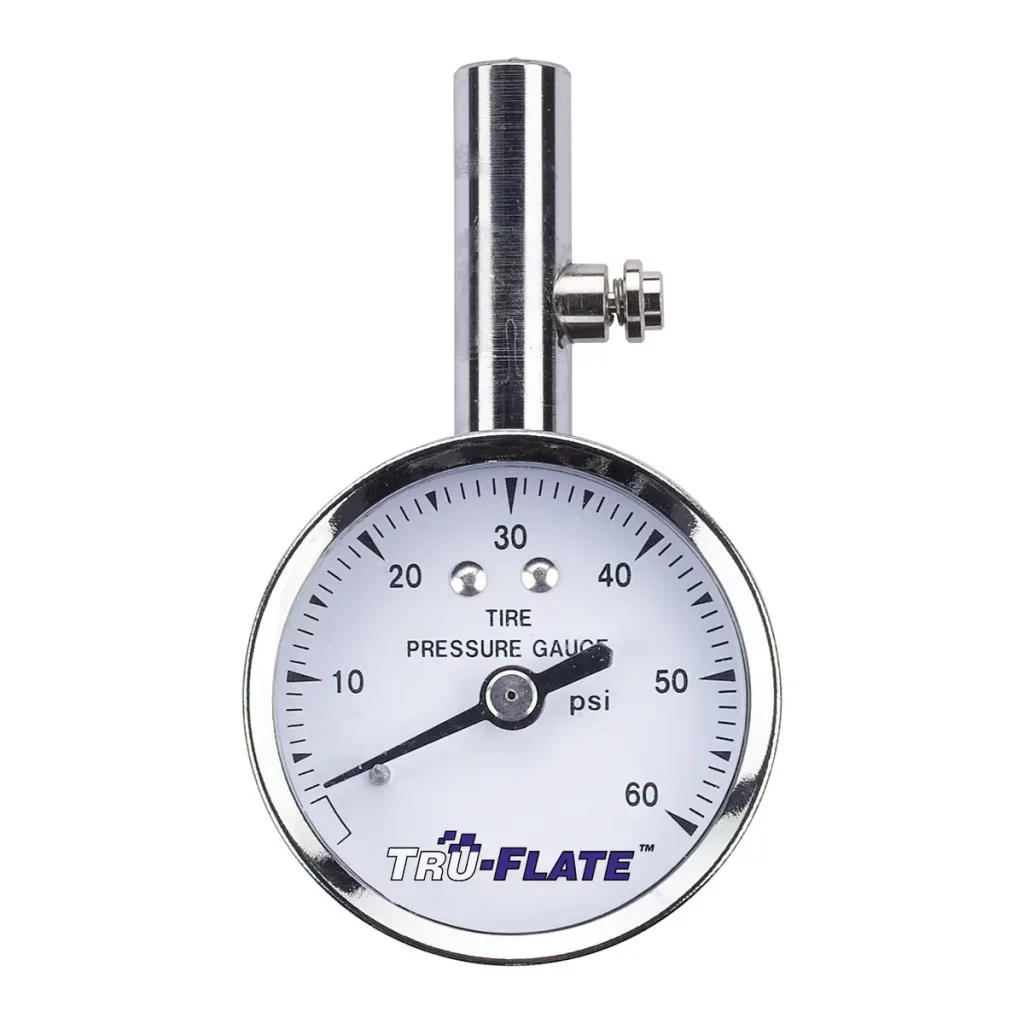
A dial tire pressure gauge is an analog pressure gauge with a dial instead of a measuring stick. To use a dial gauge, attach the gauge directly to the valve stem.
Heavy-duty dial gauges come equipped with an extension hose. If that’s the case, attach the extension hose to the valve stem.
The air pressure will go through the hose. This will cause the needle to move on the dial face. The needle will give you an accurate PSI reading for your tires.

To use a digital tire pressure gauge, attach it directly to the valve stem. A digital number will appear on the screen. This is the PSI reading. This gauge is very easy to read.
If the digital gauge doesn’t have enough battery power, your readings will be inaccurate. If you choose to use a digital gauge, we suggest you keep extra batteries in your glove box in case of an emergency.
We recommend checking the tire pressure of all four of your tires once a month. This will help maintain your car’s performance. Also remember to check the spare tire, in case you need it in a car emergency.
For more buying guides like this one, check out our Auto Parts & Tools Blog.